
Tangipahoa Parish Projected Release Dates
A projected release date is DPS&C’s current forecast based on the official sentence calculation. It can change. An actual release date records an event that has already occurred, while a discharge date may mark the end of the department’s authority. These dates are not interchangeable. A court may sign an order before jail staff complete departure processing, and supervision may begin on yet another recorded date.
Pretrial custody works differently. A person awaiting court in Tangipahoa Parish Jail has no fixed sentence endpoint. Bond, a dismissal, a plea, a sentencing order, a detainer, or a transfer can change the custody path. A listed court date is not a release promise. For a sentenced person, the sentence owner calculates time after receiving the legal papers and jail-credit information.
Scheduled versus actual: A projected date forecasts a possible exit from incarceration; only a later movement, release, or discharge record proves what occurred.
- Full-term date
- The unreduced endpoint as officially computed from the sentence.
- Projected release date
- The current forecast after applicable calculation rules and credits.
- Parole eligibility date
- The first date on which the Committee may consider an eligible person, not a promised release.
- Actual release date
- The recorded date the person left the identified incarceration.
- Discharge date
- The date the department’s authority ended for the specified sentence.
Find a Tangipahoa Parish Release Date
The verified Louisiana public route is the DPS&C imprisoned-person information page and its automated telephone locator at 225-383-4580. DPS&C says the service can return the current placement, facility address and telephone, and a projected release date if applicable. The research did not verify a stable public web-result field displaying that date, so no online label should be invented.
Use the custody and sentence path before asking for a date:
- Collect the full name, date of birth, DPS&C number if known, booking number, court docket number, and the dates of the correct episode.
- Determine whether the person is pretrial, serving a parish sentence, or committed to DPS&C. Physical location alone does not settle this question.
- For a DPS&C sentence, call the official locator and record the exact date label. If no calculation is available, ask whether sentencing papers have been received.
- For a parish sentence or pretrial case, contact Tangipahoa Parish Jail and inspect the court minutes. Ask for the actual movement record once release occurs.
- Check for a receiving agency if the record reports transfer. Departure from TPSO custody may lead to another jail, DPS&C, federal custody, or ICE.
- Confirm the outcome through a later actual-release or discharge record rather than relying on the earlier projection.
Sentence-computation questions can go to the DPS&C automated line at 225-342-0799. A confined person challenges a calculation through the facility Records Office or Administrative Remedy Process as directed by the department. For a Tangipahoa Parish jail departure, the jail inquiry line is 985-748-3236. The broader Tangipahoa Parish released-inmate search explains how to connect the jail record with the court docket.
The official DPS&C locator instructions document the telephone service used for a state release-date inquiry.
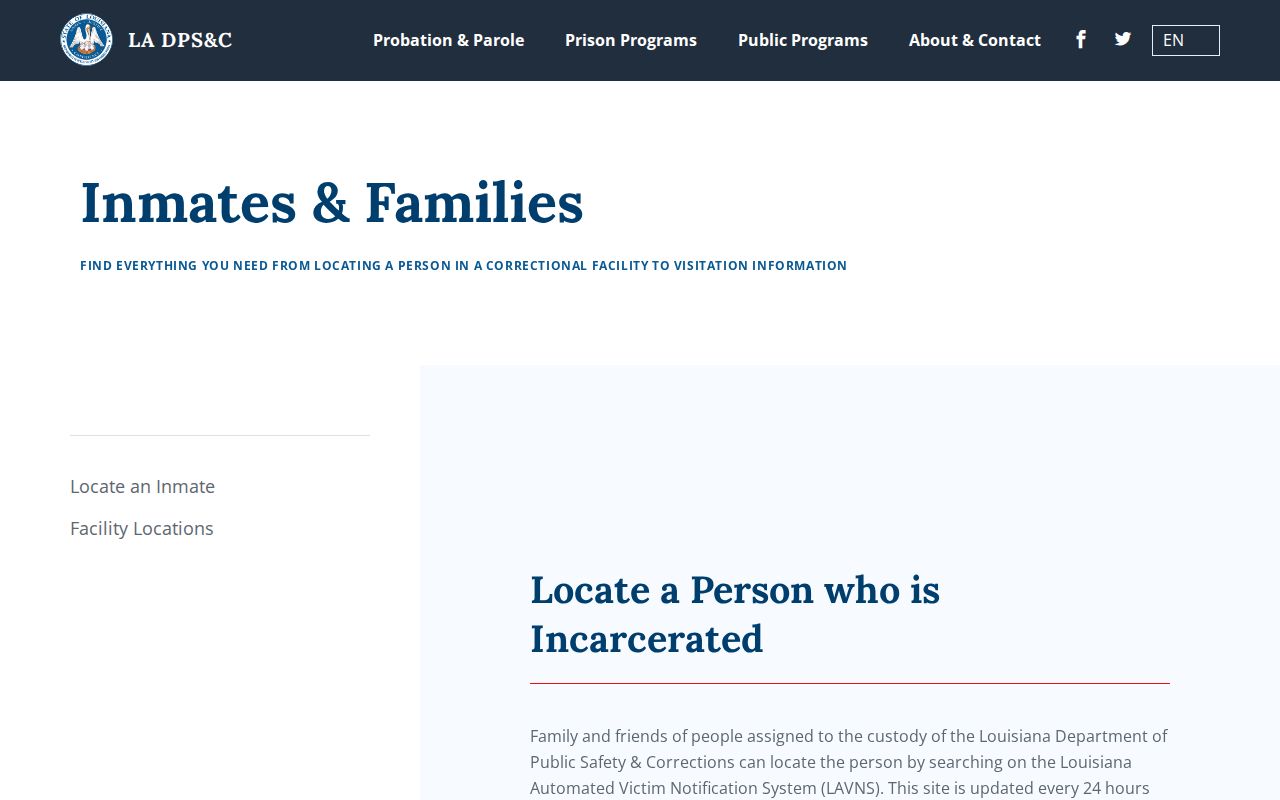
The official page supports the access route, but it does not supply a person-specific date without a matched inquiry.
Note: Ask for the exact label because projected release, parole eligibility, supervision start, and discharge describe different points in a sentence.
Tangipahoa Parish Sentence Ownership Matters
Tangipahoa Parish has an unusual practical overlap. A person committed to DPS&C may remain housed in a parish facility, and the Campo Lane complex includes both the parish jail and a separately listed transitional-work program. Neither a local address nor community work proves that the sheriff owns the sentence calculation.
For a parish-prison sentence, the sheriff or facility authority can have the statutory role in awarding applicable diminution. For a DPS&C sentence, the department computes the Master Prison Record even when the person is housed locally. The Master Prison Record embodies the official calculation. Ask one direct question before applying any credit rule: is the person a parish prisoner or committed to DPS&C?
| Custody situation | Primary date source | Main limit |
|---|---|---|
| Pretrial Tangipahoa Parish detainee | Court orders, bond record, and TPSO movement record | No fixed projected sentence date |
| Sentenced parish prisoner | Facility authority, sentencing order, and jail record | Applicable credit rules depend on the sentence and offense date |
| DPS&C-committed person held locally | DPS&C Master Prison Record and locator | Physical placement does not shift calculation ownership |
| Transitional-work participant | DPS&C status and discharge or supervision record | Community work remains custody |
A transfer closes one facility episode without establishing release to the community. Request the destination or receiving agency when TPSO records a departure, then continue with that custodian’s records.
Louisiana Good Time and Release Dates
Louisiana’s current good-time framework has a major offense-date divide. Under R.S. 15:571.3, a person who committed an offense on or after August 1, 2024 cannot earn good time except through R.S. 15:571.3.1. The newer section allows an eligible felony offender in parish prison or DPS&C custody to earn diminution up to a maximum of 15 percent of the imposed sentence. That produces the often stated 85 percent framework.
It is wrong to say that every Louisiana prisoner serves 85 percent. The rule turns on the offense date, not the sentencing date or lookup date. Sex-offense convictions and habitual-offender sentences are excluded from that subsection, and other classifications and statutory exceptions matter. Jail credit and the imposed sentence still require an official calculation. Parole eligibility is a separate question.
Earlier offenses fall under different rates, exclusions, and applicability clauses in the law governing that cohort. R.S. 15:571.3 includes rules for parish prisoners sentenced without hard labor as well as eligible DPS&C offenders. Historical law may be needed. The safest approach is to provide the identifier and offense date to the authority that owns the sentence and ask which framework applies.
DPS&C also says eligible certified programs can yield up to 360 days under R.S. 15:828(B). That is a ceiling in a defined eligibility system, not an automatic reduction. No personal date should be calculated by simply subtracting that figure or a percentage from the sentence.
When Tangipahoa Release Dates Are Missing
A missing projection may mean that DPS&C has not completed the calculation. The department must first receive official sentencing documents. Late paperwork, unresolved jail credit, or a sentence structure that has not been entered can keep the telephone service from returning an applicable projected date. “No calculation yet” is not the same as release.
This distinction is the key Tangipahoa Parish computation issue identified in the research. The mix of parish and DPS&C-sentenced people makes a source check essential. Ask which agency owns the sentence, whether the official sentencing paperwork has arrived, and whether the Master Prison Record calculation is complete. If the state service is silent for a person who appears to be in local custody, do not fill the gap with a hand estimate.
A public search can also properly omit sealed, expunged, juvenile, or lawfully confidential information. Such an absence should not be labeled a system error. Request only the public information the agency may release and ask for a legal basis if material is withheld.
Why Tangipahoa Release Dates Change
A projected date is mutable because the facts behind the official calculation can change or arrive late. Some changes alter earned credit. Others change the legal sentence or block a planned departure from becoming a community release. The official system must recalculate the effect.
| Factor | Possible effect | Record to check |
|---|---|---|
| Late sentencing papers | No projection yet or a later corrected date | Court commitment and DPS&C calculation status |
| Jail credit | Changes credited time already served | Sentencing order and Master Prison Record |
| Concurrent or consecutive terms | Changes how multiple terms combine | Judgment and official computation |
| Credit forfeiture or restoration | Moves a good-time projection later or earlier | Facility and DPS&C records under R.S. 15:571.4 |
| New court order | Modifies the sentence or release authority | Current court minutes and order |
| Detainer or receiving agency | Turns departure into transfer rather than community release | TPSO movement record and receiving-agency record |
| Parole decision | May authorize a supervised release after processing | Committee outcome and later DPS&C event |
R.S. 15:571.4 governs forfeiture and restoration of diminution and uses the term “projected good time parole supervision date.” That statutory phrase does not prove that a public web result exposes the field. It also does not mean the person has been granted discretionary parole.
Note: A detainer may change the destination without changing the fact that the person left the Tangipahoa Parish facility.
Tangipahoa Parole Dates Are Not Releases
Parole eligibility is the first point at which the Committee may consider an eligible person. It is not a guarantee. Louisiana’s rules depend on offense date, sentence, violence or sex-offense classification, recidivist status, and special provisions under R.S. 15:574.4. Newer offense cohorts were also affected by the 2024 changes to ordinary parole eligibility.
A hearing grant can require processing and conditions. A denial leaves the person incarcerated unless another lawful basis changes that status. A revocation concerns supervision after a prior release. For each path, the later DPS&C custody event is stronger proof than the eligibility date or hearing calendar.
Release by diminution can lead to good-time parole supervision. That means the person has left incarceration while the sentence continues under supervision. Full discharge comes later if and when DPS&C records the end of its authority. These terms should remain separate in every Tangipahoa Parish release date result.
Confirm Tangipahoa Parish Actual Release
After the projected date passes, check the source that controlled custody. For a parish-jail episode, request the TPSO release or movement record with the actual departure timestamp, release type, authority, and destination. For a state sentence, ask DPS&C for the public discharge date and charge or incarceration disposition under R.S. 15:574.12(G).
Louisiana LAVNS can report a custody change and supports notifications, but a supplied event may not explain bond satisfaction, the receiving custodian, or the court result. The Tangipahoa Parish VINE inmate check is useful for a pending alert. Then corroborate the event with the jail or DPS&C record.
The final wording should match the proof: TPSO recorded departure, DPS&C reports release to supervision, the Committee granted parole, or DPS&C reports discharge. A past projection is weaker than all of those completed-event records.