
Louisiana DPS&C Release Paths
Louisiana Department of Public Safety and Corrections, Corrections Services manages the state sentence trail. A person may be imprisoned in a state institution, housed under state authority in a parish facility, transferred, released to parole or good-time parole supervision, or fully discharged. No adult state prison was identified inside Tangipahoa Parish in the official directory, but state-sentenced people can still be held locally.
A move from Tangipahoa Parish Jail to a state institution is not community release. Release to supervision ends incarceration but not the sentence. Discharge is a later and distinct event when DPS&C authority ends for that sentence. Request the exact date label instead of using “release date” for all three.
| DPS&C status | Meaning |
|---|---|
| Imprisoned | Still in state incarceration, regardless of physical facility |
| Parole or supervision | Left incarceration but remains under state authority |
| Discharged | DPS&C authority ended for the sentence |
| Transferred | Custody location changed; release not established |
Confirm Louisiana State Release
Use the DPS&C imprisoned-person information page as the stable official entry. Gather the full name, date of birth, and DPS&C number when known. The automated locator at 225-383-4580 can provide placement information and a projected release date if applicable.
- Match the person through official DPS&C or LAVNS channels using more than a name.
- Record the exact custody, supervision, or discharge wording and the date label supplied.
- If the public channel is silent, request the public age, offense, conviction date, sentence length, disposition, and discharge date allowed by R.S. 15:574.12(G).
- If supervision appears, identify the Probation and Parole district through the official directory. If no calculation exists, do not treat that as release.
The Tangipahoa Parish released-inmate search explains when a local TPSO movement record should be paired with this state trail.
Louisiana DPS&C Record Contact
DPS&C’s public status entry and automated telephone locator are the verified statewide contacts in the research. The larger offender case file is generally confidential, but R.S. 15:574.12(G) makes specified general information public on request. Ask narrowly for those elements and for the agency’s definition of any date or status label.
Louisiana DPS&C
Imprisoned-person information
Automated locator: 225-383-4580
Sentence computation: 225-342-0799
Use the statewide directory for the responsible facility or Probation and Parole office.
The public elements include age, offense, conviction date, sentence length, disposition of criminal charges and incarcerations, and discharge date. Request the DPS&C number, current custody or supervision status, and public facility or district information when available. Do not demand the whole confidential file.
Louisiana State Custody Records
DPS&C is a statewide correctional system, not a parish jail. Its Master Prison Record carries the official sentence computation. Physical placement does not decide who owns that calculation. A person committed to DPS&C may remain in a local jail, move to a state institution, or enter a transitional-work program while still incarcerated.
The Tangipahoa Transitional Work Program is separately listed at the Campo Lane complex. Community work is not release. Confirm the later move to supervision or discharge through DPS&C. Likewise, a parole eligibility date is only the first possible consideration date for an eligible person. It is not a promised release date.
- Projected release date
- The current official forecast, subject to change.
- Parole eligibility date
- A possible consideration date, not a release order.
- Actual release
- The event ending incarceration, sometimes into supervision.
- Discharge
- The end of state authority for the sentence.
Louisiana Discharge Record Fields
The research did not verify a stable public web-result field labeled projected or tentative release date. The telephone locator, however, officially supplies a projected release date when applicable. Capture the exact label and access date. Do not calculate a personal date from a sentence, offense, or general good-time rule.
A projection can change because of late sentencing paperwork, jail credit, concurrent or consecutive terms, offense-date law, statutory exclusions, earned diminution, loss or restoration of credits, parole action, or a new court order. A later completed discharge record is stronger evidence than an earlier forecast.
The official DPS&C status instructions are shown on the department page.
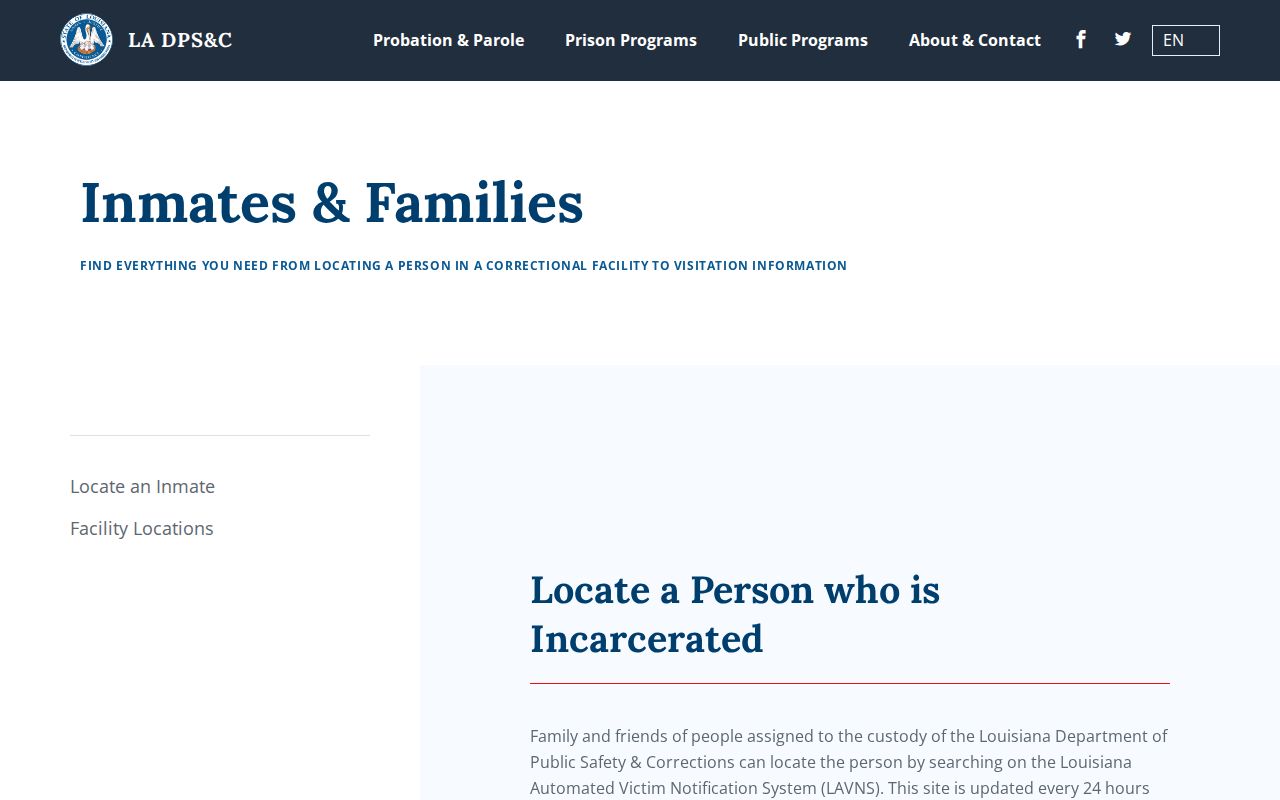
The image documents the statewide route, not a personal result or guaranteed release date.
Louisiana Release Versus TPSO
A TPSO departure to DPS&C closes the parish-jail episode but continues incarceration. Conversely, a DPS&C-sentenced person can be physically housed at Tangipahoa while the state owns the sentence. Ask both questions: where was the person held, and which authority controlled the sentence?
When DPS&C reports supervision, use the Division of Probation and Parole directory to identify the responsible office. When it reports discharge, retain the exact date and source. A missing parish roster result adds no proof to the state status.
Note: “No calculated date” can mean sentencing paperwork is incomplete; it does not mean the person has been released.
Louisiana Good-Time Release Rules
Louisiana good-time law depends heavily on the offense date and sentence. For offenses on or after August 1, 2024, R.S. 15:571.3 and 15:571.3.1 establish a framework in which an eligible felony offender may earn diminution up to 15 percent, with exclusions and added rules. That does not support a claim that every person serves the same percentage. Earlier offenses fall under different rates, exclusions, and applicability clauses.
R.S. 15:571.4 governs forfeiture and possible restoration of diminution credits. A disciplinary loss can move a projection later, while restoration can change it again. Certified programs can also affect eligible people under the specific reentry framework, but the published ceiling is not an automatic credit for everyone. Only DPS&C’s calculation should be reported for a named person.
Parole adds a separate decision path. The Louisiana Committee on Parole publishes dockets and outcomes, but a hearing date is not a release date. A grant can require processing and conditions. A denial leaves incarceration in place. A revocation proceeding concerns supervision after release. Verify the actual later custody event through DPS&C or LAVNS instead of predicting it from a docket.
Louisiana Release Supervision Status
State LAVNS data can include imprisoned people and those under probation or parole supervision. DPS&C says state data update every 24 hours. That channel helps distinguish incarceration from supervision, but it does not replace a public discharge request. Louisiana Victim Outreach registration is a separate state notice route for eligible projected and actual release notices.
For Tangipahoa, the Amite Probation and Parole office serves the district covering Livingston, St. Helena, and Tangipahoa parishes. A supervision-office confirmation is stronger than a general roster inference. If supervision has ended, request the discharge date. If a person is listed as an absconder, that describes an alleged supervision violation and is not proof of the original release date.
Request Louisiana Discharge Records
DPS&C public information and the broader case file have different access rules. R.S. 15:574.12(G) identifies general facts available on request, while much of the full offender file remains confidential. A focused request for the discharge date, charge and incarceration disposition, sentence length, and conviction date is more defensible than a demand for every case note. Ask the department to define whether a date is projected, actual, supervision start, full term, or discharge.
Record retention is longer than online visibility. R.S. 44:36 contains a specific adult-offender retention rule tied to full-term expiration or death. That does not mean every retained field appears in a public locator. A silent web result should lead to the official phone and records route, not a conclusion that no state sentence existed.
Identity matching requires the DPS&C number when possible, plus name and date of birth. A parish booking number is a different identifier. Keep both when one custody chain crosses TPSO and the state. If dates or identifiers conflict, ask the agencies to reconcile their own records and do not merge the episodes.
Louisiana’s release dashboard and annual statistics provide aggregate context, not proof about a named person. A statewide count cannot confirm an individual Tangipahoa release. Use person-level status, discharge information, and the actual movement record for that task.
When the person remains under supervision, record the responsible district and the exact supervision type. Probation, parole, good-time supervision, and discharge are not synonyms.
The state route can also resolve a Tangipahoa transfer that looks like release on the parish side. Ask TPSO for the receiving authority and departure time, then ask DPS&C for the matching state identifier, placement or supervision status, and public discharge data. The paired records show where the local episode ended and where state responsibility began without turning the transfer date into a community release date.
Keep both agency identifiers with the result.