
Tangipahoa Parish Booking Photo Records
A booking photograph documents appearance at the time of an arrest or jail intake. Release does not change what the image originally recorded, but it does change the need for context. A photo does not prove guilt, sentence completion, the reason for departure, or current custody. It should remain tied to the correct booking episode and the agency that created it.
Louisiana Code of Criminal Procedure article 228 requires a public booking book with specified fields such as name, address, property taken, and booking date and time. The statute does not expressly list a photograph among those mandatory fields. Article 234 defines a booking photograph and regulates certain publishers, but it does not command every jail to publish every photo. A TPSO image is therefore requestable subject to the custodian’s response and applicable law, not automatically available.
The live Tangipahoa roster is a current-custody starting point, not a released-photo archive. Once a person drops from the public view, the retained booking record may still be requestable even though the image no longer appears online. Record retention and online display are separate issues.
Where Tangipahoa Parish Mugshots Appear
Each official channel covers a different record set. Start with the booking agency and expand only when the custody trail points elsewhere. A municipal arrest, a parish booking, and a DPS&C sentence should not be merged just because the names match.
| Channel | Has photo? | How to access |
|---|---|---|
| TPSO-linked TBS roster | An image position may appear, but photos were not verified for every detail | Search the official roster and open the matched booking detail |
| TPSO public-record request | Requestable if public and retained; production is not guaranteed | Specify the person, booking episode, and photograph through NextRequest |
| Official TPSO app | Store descriptions do not promise a mugshot or release-photo feed | Check the current agency-approved app menu without assuming a feature |
| Louisiana DPS&C | No public released-record photo field was verified | Ask narrowly for public identifying material tied to the state record |
| Official offender registry | Can show identifying material for people with a legal registration duty | Use only when registry status is relevant; it is not a general jail archive |
| TPSO news releases | Sometimes, for selected events | Search official agency news and confirm the image’s credited source |
| Commercial or other third-party pages | Sometimes, but images may be stale or misidentified | Treat only as a lead and return to the booking agency; no commercial source is endorsed or linked |
VINELink or local LAVNS may help identify the reporting agency and custody event, but the research did not establish them as reliable photo sources. Their main function is status and notification. A Tangipahoa Parish mugshot should be confirmed against the sheriff, police department, court, or DPS&C record that owns the episode.
The Tangipahoa Parish released-inmate search supplies the custody and release trail needed to place a booking photo in the correct case context.
Note: Match date of birth, booking number, docket, and arresting agency before treating any image as the correct Tangipahoa Parish record.
Tangipahoa Roster Photo Availability
The TPSO-linked TBS roster showed name, date of birth, race and gender, booking date, and detail links when reviewed. Sampled detail records contained an image position, but the inspection did not reliably produce a booking-photo URL. That narrow finding supports “may contain an image position,” not a claim that every current or released booking has a visible photograph.
The roster also lacked a released-status filter, release-date column, and recent-release window. TPSO’s jail guide describes current and released inmate information more broadly, but the observed vendor interface did not expose a usable released-photo gallery. Sorting by booking date orders admissions. It does not identify who left custody or when.
Important: A blank image position may reflect availability, retention, access limits, or the particular record; it does not prove that no photograph exists.
If a matched detail shows an image, retain the booking number, the access date, and the source. Then use the release record to learn what happened after the booking. If no image appears, the official records request is the systematic fallback.
Request Tangipahoa Parish Booking Photos
TPSO directs all public-record requests through NextRequest as of April 15, 2026. A photo request should identify one booking episode and ask for the retained image, not for a broad search by name. Include enough identifiers to avoid a false match but do not transmit data that the custodian does not need.
Use the following sequence:
- Confirm the booking agency. If Hammond or Amite police released the person before a parish transfer, that municipal agency may own the image.
- Open the TPSO public-records page and follow its current NextRequest instruction.
- Give the full name, date of birth, booking number if known, and the approximate booking date.
- Ask for the booking photograph from that episode if it is public and retained. Request the related release or movement record when custody outcome also matters.
- Ask for electronic production, an estimate before fees are incurred, and the legal basis for any withholding or redaction.
- Save the agency response and code definitions with the image so its source and context remain clear.
TPSO publishes a current fee-schedule link, but the numerical amounts were not reliably extracted in the research. Do not assume a charge. Ask for an estimate tied to the requested medium and category. The Criminal Records Office can assist with the portal at 985-345-6150.
The official TPSO request instructions show the public channel and fee-schedule entry point.
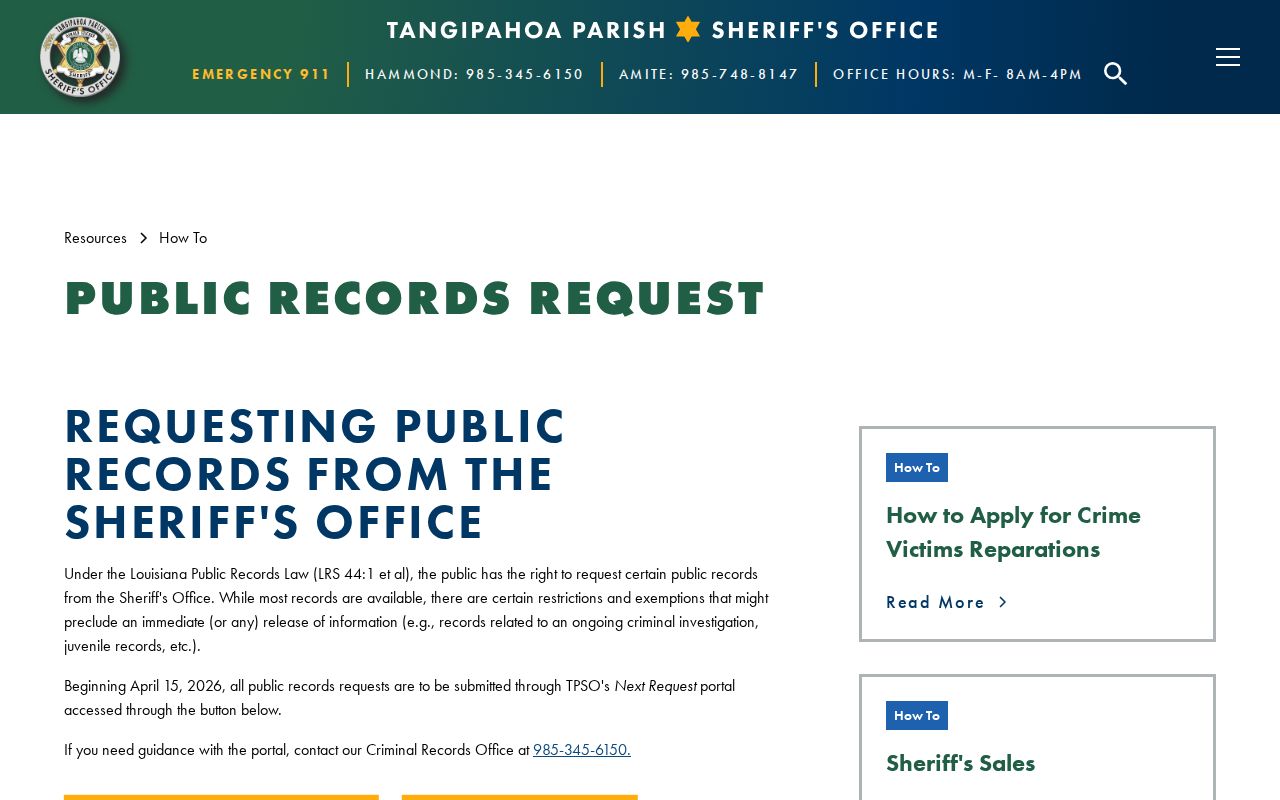
The request page is the proper route for a retained booking image when the live roster does not show one.
A focused request can cite Louisiana Public Records Law without claiming that every photograph must be released. R.S. 44:3 protects specified investigative and security material while preserving public access to initial reports and article 228 booking records. If TPSO withholds the photo, request the legal basis and any segregable public portion.
Tangipahoa Sheriff App Photo Limits
TPSO has official apps on Apple’s App Store and Google Play. Their agency-approved descriptions promote tips, alerts, messages, and services. They do not promise a recent-release window, inmate module, or mugshot archive.
The app can be checked as a local official channel because menus and features may change. Yet a user review, an old screenshot, or the generic word “services” is not enough to claim that it displays released-person photographs. Verify the current menu directly and record the version or access date if a relevant module appears.
TPSO social pages also publish selected public-safety items. Those posts are not a systematic feed of everyone booked or released. An image in a post should be tied to the article’s event and credited source, then checked against the agency record.
The Tangipahoa Parish 24-hour releases page explains why the live roster and app cannot be relabeled as a same-day departure feed.
Tangipahoa Release Photos in News
TPSO news releases sometimes include an arrest or booking image for a selected event. A January 2026 transitional-work story credited an image from another detention center. That detail shows why provenance matters: a photo published by TPSO may still have been created by a different custodian.
News coverage is selective and event-driven. It may document an arrest, escape, rebooking, or transfer rather than a lawful release. A headline or image should not be used to infer that a person has left custody. Check the date, caption, credited agency, and later movement record.
Other news organizations and third-party pages may retain images after the official public view changes. They are not authoritative custody sources. No commercial mugshot publisher, data broker, or removal vendor should substitute for the sheriff’s record, and none is linked here. If an outside image provides a lead, match it to an official booking number before drawing any conclusion.
Louisiana Release Photo Sources
DPS&C public information serves a state-sentence trail, not a Tangipahoa Parish booking archive. The research did not verify a public released-record photo field or a right to the full state case file. R.S. 15:574.12 makes limited general information public, including age, offense, conviction date, sentence length, disposition, and discharge date, while the larger offender file is generally confidential.
Ask DPS&C narrowly whether public identifying material is associated with the state record. Do not promise an image. A DPS&C photo, if lawfully provided, would relate to the state record and should not automatically be labeled the Tangipahoa Parish Jail booking photo.
The Louisiana State Police and sheriff-linked offender registries are another narrow channel. They apply only to people with a legal duty to register. A registry result does not prove release from Tangipahoa Parish Jail or provide a general photo archive for all released people. Use it only when the registry status itself is relevant and retain its update context.
Juvenile records require a different rule. Florida Parishes Juvenile Detention Center is not part of the adult public released-inmate path. Authorized inquiries belong with the juvenile court, counsel, facility, parent or guardian, and other lawful channels under the applicable confidentiality rules.
Tangipahoa Expungement and Photo Access
The Tangipahoa Parish Clerk’s Criminal Department directly links Louisiana’s official expungement form set. Under Code of Criminal Procedure article 971, expungement removes a record from public access but does not destroy it. Article 972 includes photographs, fingerprints, dispositions, and related arrest-event material within the covered records. Article 973 makes the expunged record confidential subject to statutory access routes.
That means a photograph can lawfully disappear from a public search even though the underlying record was not erased. The result should not be described as a database failure. Expungement eligibility is fact-specific, and no universal waiting period should be assumed. The current statutes and forms control.
The Tangipahoa Clerk Criminal Department provides the local form route for 21st Judicial District matters. Hammond City Court is a separate jurisdiction for Seventh Ward misdemeanor and traffic matters, so the correct court depends on the case. A court order and the booking agency’s response may both be needed to address public access.
Note: A sealed or expunged Tangipahoa Parish photo may be absent for a lawful reason, not because the person or booking was misidentified.
Louisiana Mugshot Removal Policy
Code of Criminal Procedure article 234 regulates covered remove-for-pay publishers. After a qualifying request supported by evidence of acquittal, nonprosecution, expungement, vacatur, or pardon, the publisher must remove and destroy the photo within seven calendar days and may not charge for doing so. The law can provide civil consequences, and seeking payment can implicate R.S. 14:66.
This rule is an anti-pay-to-remove remedy. It is not a universal command that every government agency publish a booking photo, nor does it make an old image a current custody record. The supporting proof and the publisher’s status under the law matter. Official-source correction or access questions should go to the source agency, while an expungement question belongs in the proper court process.
Use restriction: Tangipahoa Parish Released Inmates is not a consumer reporting agency under the Fair Credit Reporting Act. Mugshot information cannot be used for credit, employment, tenant, insurance, or another FCRA-covered purpose, and records may be incomplete or outdated.
The safest record practice is simple. Preserve the source, booking episode, and date; check for a later court or agency action; and avoid recirculating an image without its legal and custody context.