
Tangipahoa Parish Three-Day Release Records
No distinct TPSO, TBS, or local LAVNS page was found that publishes a rolling list of people released during the prior 72 hours. The three-day product must be built from an existing release or movement log supplied by the Tangipahoa Parish Sheriff's Office. Submit the request through TPSO NextRequest. State the interval precisely and say whether it should include all departures or only recorded releases to the community.
A 72-hour span is useful when a reader knows only that a departure occurred “over the weekend” or “within the last few days.” Those phrases are not precise enough for a records request. A running 72-hour window can begin in the middle of one day and end in the middle of another. A three-calendar-day request uses different boundaries. Write the exact Central time start and end, including the date for each. This keeps the result reproducible and prevents a later reader from applying a different window.
Build Tangipahoa Parish 72-Hour Window
The request should seek records that TPSO already keeps, not ask staff to decide who was legally “free.” A jail movement report may contain releases, transfers, writ returns, and pickups by other agencies. Ask for the agency's own movement type and code definition. Then use the destination field and another official source to classify each event.
- Choose a rolling 72-hour span or three complete calendar days and write both boundary timestamps in Central time.
- Open the TPSO public-records page and submit the request through NextRequest.
- Ask for the full name, booking number, actual departure time, movement type, code definition, authority, and destination for each entry.
- Separate records showing community release from those naming DPS&C, another jail, federal authorities, or ICE as the recipient.
- Check the court docket or receiving agency for each event that still needs a legal or custody explanation.
When the search concerns one named person, list the full name, date of birth, booking number if known, and approximate dates. This reduces false matches and may be faster than requesting a bulk log. The Tangipahoa Parish released-inmate search combines the named-person paths for local, state, federal, and immigration records.
Ask for an electronic copy and a current fee estimate before the request is processed. TPSO links a fee schedule, but its figures were not reliably extracted in the research. Do not assume that a particular charge applies.
Louisiana Public Records Law also shapes the response. Article 228 requires a booking book with core admission facts, but it does not list release time, release reason, or photograph among the mandatory fields. Request those items by name. If TPSO withholds a part of the record, ask for the legal basis and any portion that can be separated and released. An ongoing investigation or a juvenile matter may lawfully limit access without making the request process itself invalid.
Tangipahoa Parish Roster Limits
TPSO's jail guide describes the linked roster as providing information about current and released inmates. The observed TBS roster, however, does not expose a released tab, release date, release reason, status filter, or 72-hour selector. It displays booking-focused fields. That interface cannot be relabeled as a three-day departure list.
The captured roster screen documents both the visible controls and the missing recent-release window.
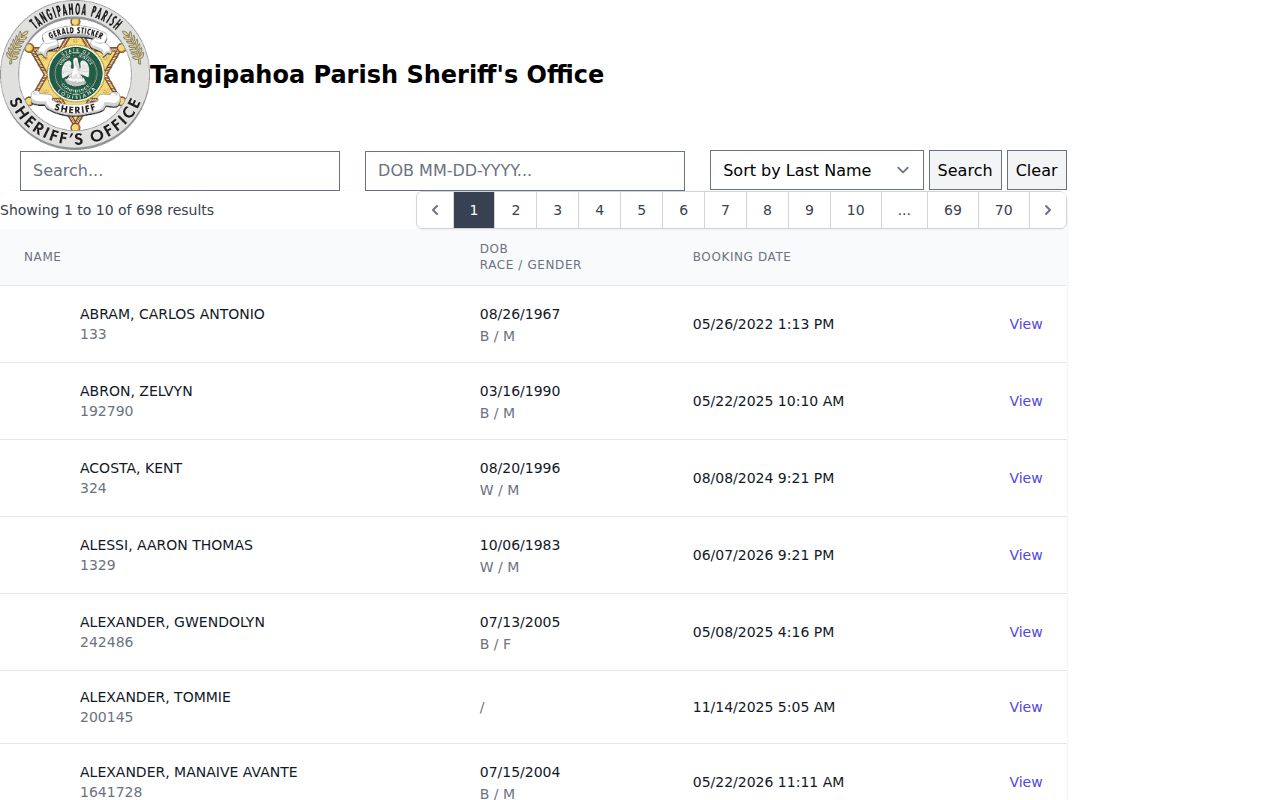
The image helps explain why three daily screenshots should not be merged and called a release list. A record that disappears between snapshots might reflect release, transfer, correction, lawful restriction, or a data issue.
Booking Date sorting concerns admissions. It does not show departures. Likewise, a count of listed records is a momentary roster count, not a count of releases during the interval. No official TBS refresh cadence or online post-release retention period was found. The local LAVNS page shows a last-updated timestamp when available, but that timestamp belongs to LAVNS and must not be assigned to TBS.
Note: Quote the timestamp displayed by the source at access time; never promise that the Tangipahoa Parish roster updates in real time.
Review Tangipahoa Parish Release Fields
A three-day result should carry enough fields to tie each departure to the right person and booking. The live roster's published list fields can help with identity, but the requested movement log supplies the key release facts. The table separates what was observed online from what should be requested from TPSO.
| Field | Role in a 72-hour check |
|---|---|
| Name and date of birth | Observed on the roster and useful for matching, but not enough alone. |
| Booking date | Observed admission date; it does not prove departure within the window. |
| Booking number | Requested key that links the movement to one custody episode. |
| Departure timestamp | Requested value that determines whether the event falls inside the defined span. |
| Release or movement type | Requested agency label distinguishing bond, court order, sentence end, transfer, or another outcome. |
| Authority or order | Requested basis for the departure as recorded by the jail. |
| Destination or recipient | Requested field showing whether another custodian took control. |
The code definition deserves special attention. TPSO may use its own short labels. The research does not claim those codes match generic release terms. Quote the record first, obtain the custodian's definition, and then explain only the custody consequence it supports.
Three dates may appear across the file. A judge can sign an order first. Jail staff may process the actual departure later. A supervision term can begin or be entered on another date. The release list should use the actual jail departure timestamp for the 72-hour test while preserving the order and supervision dates under their own labels. A projected date belongs to neither category because it can change before the event occurs.
Weekend Tangipahoa Parish Release Checks
A broader window can catch a departure when the person checking did not know the exact day. It does not mean TPSO uses a special weekend publication schedule. No official evidence was found for routine release hours, weekend or holiday processing practices, a public waiting area, or a standard transportation service. Those operational details must be confirmed with the jail rather than inferred from common practice elsewhere.
For a Friday-through-Monday inquiry, write the specific timestamps rather than “the weekend.” If a judge signed an order on Friday, the jail's actual departure time may differ. The court minute shows the legal action; the TPSO record shows physical departure. A supervision start date can be different again. Keep those dates separate.
Call the jail inquiry line at 985-748-3236 for an urgent current-status question. For documentary proof, use NextRequest. If the record shows a 21st Judicial District matter, consult the Tangipahoa Parish Clerk. A Seventh Ward misdemeanor or traffic case may instead belong to Hammond City Court. Searching only one court can leave the reason for release unresolved.
The Tangipahoa Parish 24-Hour Releases method is better for a single calendar day or same-day check. Both windows require the same movement evidence.
Confirm Tangipahoa Parish Custody Outcomes
Once the 72-hour log arrives, route each entry by destination. A release on bond ends the jail stay while the case may remain pending. A court-ordered release needs both the court action and actual jail departure time. Sentence completion ends the confinement described by that record, but state supervision can still continue. A transfer closes the TPSO episode without proving community release.
| Recorded outcome | Next confirmation source |
|---|---|
| Community release or bond | TPSO movement record plus the correct court docket. |
| Louisiana DPS&C transfer or supervision | DPS&C imprisoned-person information and official status assistance. |
| Another parish or municipal jail | The named receiving facility's current record or records office. |
| Federal transfer | BOP locator after commitment, or the federal court trail for pretrial custody. |
| Immigration transfer | ICE detainee locator and detention contacts when ICE custody is independently indicated. |
| VINE custody change | The supplying facility or agency release record for the exact meaning. |
Louisiana VINELink can support a person-specific custody check or status alert. It is not a substitute for a bulk three-day TPSO log. A VINE alert shows that a participating agency supplied a custody change; it may not state bond satisfaction, receiving custodian, or court disposition. If the event matters, obtain the jail or DPS&C record.
Identity control remains essential across a multi-day list. Match date of birth, middle name, booking number, agency number, docket number, and episode dates. Never merge records solely because names match. When identifiers conflict, the records do not support a confident link.
Finally, treat lawful absence with care. Expunged, sealed, confidential juvenile, and exempt investigative records may not appear in a public search. That is not proof of a broken system. Ask the custodian for the access basis, but do not try to work around a lawful restriction. A three-day list is only as complete as the public records that the responsible offices may release for that interval.