
Federal BOP Release Meaning
The Federal Bureau of Prisons holds people serving federal sentences. Its public locator can report a release date and status such as “RELEASED” or “Not in BOP custody.” That means the person is no longer in BOP custody as recorded. It does not rule out federal supervised release, ICE detention, state or parish custody, or a new case.
No BOP institution was found in Tangipahoa Parish. A person arrested locally on a federal matter may first move through the U.S. Marshals Service, which handles many pretrial and transport functions. USMS has no comparable public historical locator. After federal commitment, BOP becomes the main prison trail.
| Federal result | What it proves | What it does not prove |
|---|---|---|
| Released with date | BOP custody ended on the displayed date | No other custody or supervision |
| Not in BOP custody | Person is not presently held by BOP | Community freedom |
| USMS transfer | Federal pretrial or transport custody may continue | BOP release |
| TPSO departure to federal authority | Parish custody ended by transfer | Community release |
Confirm a Federal BOP Release
Open the BOP Inmate Locator. An agency identifier gives the strongest search. BOP supports its register number as well as DCDC, FBI, and former INS numbers. A name search can be narrowed by age, race, and sex.
- Search by the federal identifier when available. Otherwise enter the full name and use the offered filters.
- Compare the name, register number, current age, race, and sex. Do not choose a result by name alone.
- Record the exact release date, location, and custody wording shown by BOP.
- Check the federal docket for legal disposition or supervised-release terms. If another custodian is indicated, continue with that agency.
When the federal trail began with a TPSO transfer, the Tangipahoa Parish release-record path can establish the local departure and named receiving authority.
Federal BOP Locator Contact
The federal system page is a network-level resource because no local BOP institution was identified in Tangipahoa Parish. Use the locator for post-sentence BOP records. For federal pretrial disposition, use the federal court docket and, when needed, a properly scoped USMS or agency records request.
Federal Bureau of Prisons
BOP Inmate Locator
Federal inmate records from 1982 to the present
Older records may require the National Archives.
A local sheriff record saying “USMS” or “federal pickup” should be quoted as a transfer. It does not predict where the person was housed, whether a federal court later ordered release, or whether BOP ever accepted the person after sentencing.
Federal Release Record Fields
BOP locator results can include name, register number, current age, race, sex, release date, and location. The locator covers federal inmates from 1982 to the present and is updated daily according to BOP. Update cadence does not turn the result into a full case history.
The release date should be copied with its label. A federal judgment and docket can explain the sentence and supervised-release term, while the BOP record supplies the prison-custody result. Older federal prison records may require the National Archives.
- BOP register number
- The federal prison-system identifier used for the strongest locator match.
- Released
- No longer in BOP custody for that recorded episode.
- Supervised release
- Federal court supervision after incarceration, distinct from BOP custody.
- USMS custody
- Federal pretrial, court, or transport custody outside the public BOP release trail.
Federal Release Locator View
The official BOP locator is the matched federal source captured for this project.
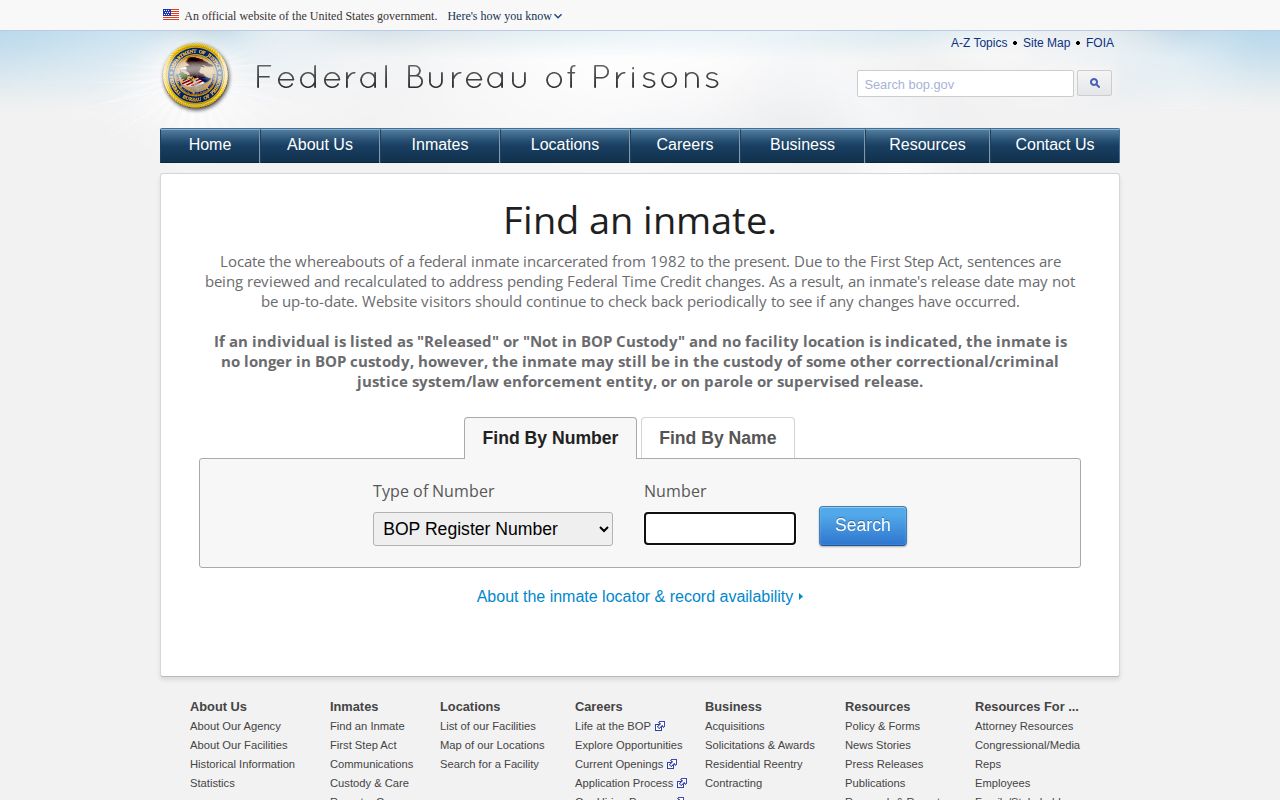
The captured page shows where to search; it is not evidence about any named person or Tangipahoa Parish Jail release.
Federal Release Versus Tangipahoa
A TPSO movement record and BOP result answer different questions. TPSO can document when the parish stopped holding a person and to whom custody moved. BOP can document a federal prison status and release date. The time between those events may include USMS custody, federal court proceedings, transport, or another facility.
ICE is also separate. A person can complete BOP custody and enter civil immigration detention. Search ICE only when immigration custody is independently indicated. Conversely, a BOP result cannot establish an ICE release. Keep each agency’s status in its own sentence.
Note: BOP “Released” does not erase a later local booking or prove that federal supervision has ended.
Match Federal Release Identities
Federal identity matching deserves care because the locator spans decades and many jurisdictions. A BOP register number is stronger than a name match. When only a name is available, compare the middle name, age, race, sex, and known case dates. Preserve the register number from the matching result and use it when reviewing the federal docket. If key identifiers conflict, do not merge the records.
The locator’s 1982 starting point creates an older-record gap. BOP directs older federal prison research toward the National Archives. That historical route differs from the ICE 60-day released-person window and from TPSO’s unstated online retention. Report the coverage of each system instead of treating nonappearance as a universal release signal.
Federal supervised release is imposed and administered through the federal court system. It is not Louisiana parole and does not appear as a Tangipahoa Parish Jail release. The judgment and docket can show the term and later court action, but the BOP locator remains the prison-custody source. If the question is whether supervision ended, use the federal court or responsible federal supervision authority.
USMS custody fills another gap. The Marshals Service can manage a person before trial, during court proceedings, and in transport. Its restricted tracking system is not a public locator like BOP’s. For a federal pretrial release, consult the federal docket and a properly scoped agency request. Do not expect BOP to show every person held for a federal court.
Trace Federal Custody Transfers
A Tangipahoa sheriff record should identify the receiving authority when a federal transfer occurs. Request the actual departure time and movement-code definition. Then start the federal trail at the named agency. This preserves the distinction between release from TPSO, federal pretrial custody, BOP imprisonment, and later BOP release.
The federal court docket adds the legal context BOP does not supply. It can show detention or release orders, judgment, sentence, supervised-release terms, and later court action. A docket order may precede the actual movement from a facility, so it should not replace the BOP custody date. Use the order to explain authority and the locator or agency record to confirm the physical status.
BOP updates its locator daily, but a daily cycle is not real-time proof of a movement that just occurred. Record the search date and check again when the known event is recent. If urgent, use the responsible institution or federal authority identified in official records. Never assign BOP’s update statement to TPSO, ICE, or USMS.
Federal Release Coverage Limits
If a BOP result lists a past release, search no further only when the question is limited to that federal prison episode. A person reconnecting with family may also need to know whether another agency took custody. Check a later TPSO episode, ICE transfer, or state record only when a source supplies a reason to do so. Avoid broad speculation.
Federal records before 1982 call for archival research with the National Archives and enough identifiers to find the right person. Do not treat locator nonappearance as evidence of release for an older sentence. The coverage date is a system boundary, not a custody event.
A federal sentence can end in stages. BOP prison custody may end first, followed by court-ordered supervised release. Later discharge from supervision is a court question, not a second BOP prison release. Keep those dates distinct.
When a result lists a location instead of a past release, the person remains in the BOP trail as displayed. Use the official facility listing tied to that result. No Tangipahoa address should be inserted merely because the arrest occurred in the parish.
A release date can be corrected when agency data changes. Save the access date and verify discrepancies with BOP or the federal docket. An older screenshot supports context but does not overrule a newer official record.
No BOP institution was identified inside Tangipahoa Parish. That finding matters because the system page describes the federal record trail, not a local prison address or visiting point. Use the facility shown in a matched BOP result for current contact information. Do not insert a Tangipahoa location merely because a local arrest or parish-jail transfer began the broader federal custody chain.